Most of the small growing businesses operate without a proper Human Resource Management (HRM) system. This may seem cost-efficiently in the initial phase but creates serious operational problems over the time.
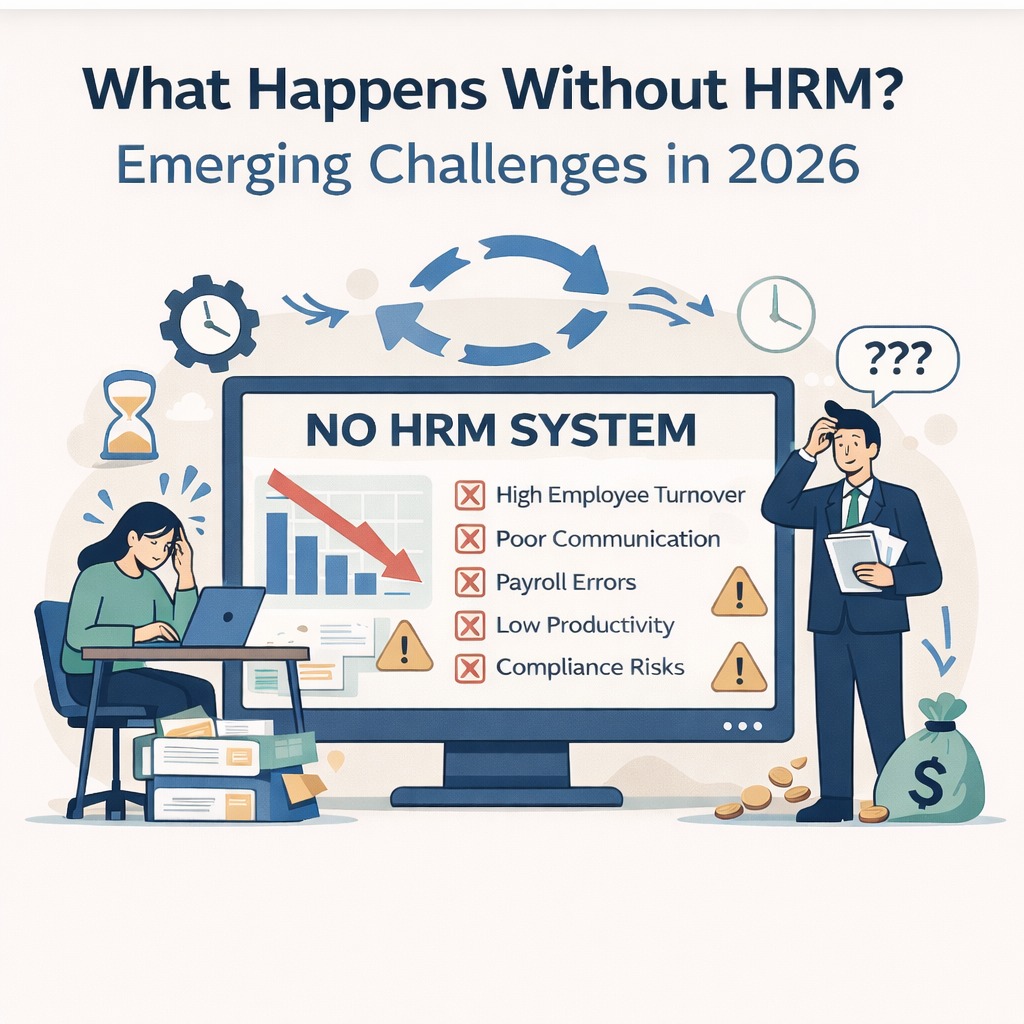
Let’s understand the Emerging Challenges Without HRM and Why Structured HR Management is Essential in 2026.
Unstructured Hiring Process
Without it:
- There is no clear workflow
- Delayed hiring decisions
- No proper candidate tracking
- Higher chances of hiring a wrong candidate
This leads to increase in hiring cost additionally low turnover.
Low Employee Satisfaction
When there is no system to track:
- Employee Satisfaction
- Performance Reviews
- Career Growth
Employees feel undervalued additionally start looking for better opportunities.
Payroll Errors & Compliance Risks
Manual Payroll processing results in:
- Miscalculations in Salaries
- Tax Filing Errors
- Delayed Payments
- Legal Penalties
Without it business can be in risk violating labour laws, which can lead to face fines.
Lack of Employee Performance Monitoring
Without HRM tools company can’t measure:
- It’s Productivity
- Attendance
- Employee Leaves
- Goal Tracking
Therefore it makes performance management very specific rather than making it data-driven.
Poor Workforce Planning
HRM System help forecast:
- Hiring Needs
- Skill Gaps
- Training Requirements
However without it, business struggles with understaffing and overstaffing.
Communication Gaps in Remote Work
In hybrid or remote environments, absence of structured HR systems leads to:
- Poor coordination
- Lack of accountability
- Reduced engagement
This affects overall productivity of the business.
No Data-Driven HR Decisions
Modern businesses rely on HR analytics to make smart decisions. Without HRM software, companies cannot track:
- Employee Data
- Hiring cost per employee
- Employee engagement matrix
- Workforce trends
Decision-making becomes guesswork instead of strategy.
Increased Administrative Burden
Without automation, HR tasks like:
- Maintaining employee records
- Tracking leaves
- Managing documentation
- Handling onboarding
Become time-consuming and error-prone.
Why Businesses Cannot Ignore HRM in 2026
The business environment is becoming more competitive, digital, and compliance-driven. Operating without HRM may work in the early stages, but as the company grows, the challenges multiply.
An organized HRM system helps businesses:
- Save time
- Reduce errors
- Improve employee satisfaction
- Stay legally compliant
- Make strategic decisions
Final Thoughts
Running a business without HRM is like driving without a dashboard—you won’t know what’s going wrong until it’s too late.
As workforce expectations evolve and regulations tighten, companies that fail to implement structured HR systems will struggle with inefficiency, legal risks, and high employee turnover.
If you’re planning to scale your business, investing in a proper HRM system is not an option—it’s a necessity.